
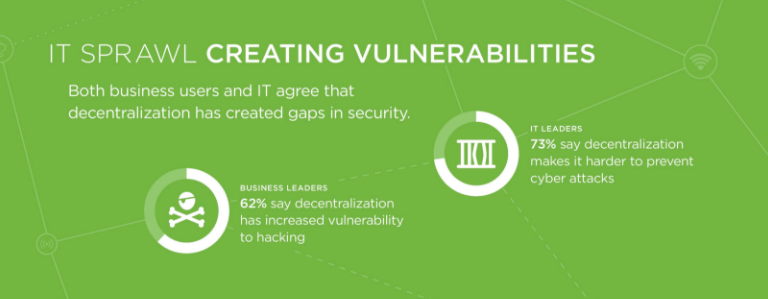
IT is becoming increasingly decentralized, with purchasing and management decisions being made at the business level. As cloud computing continues to move technology beyond IT, data is increasingly at risk. According to a new study by VMware, 69% of respondents believe IT has become increasingly decentralized over the past 3 years and 57% agree that this decentralization has resulted in the purchasing of non-secure solutions.
“The IT Archipelago: Fragmentation Stressing the Enterprise,” a study conducted by Vanson Bourne for VMware, polled 3,300 IT decision makers and business decision makers across 20 industries and 20 countries. The results of the survey mirror those demonstrated last month by Oracle; namely, that IT spending is being driven by individual business units resulting in an explosive growth in Shadow IT practices, creating dangerous “data silos.”
“IT isn’t ready for this transition and it may be causing more harm to businesses than good, specifically around security,” The IT Archipelago: Fragmentation Stressing the Enterprise
The majority of technologies decentralized to business units include authorization for new devices (BYOD), purchasing third party apps, building apps, or developing cloud services. According to earlier findings, the average organization use 841 cloud apps; this new research suggests that cloud services have been key to the digital transformation, with cloud purchases being made at the business level to “drive innovation within their domains,” which while well-intentioned does come with security and compliance issues. According to the VMware study, 56% believe that decentralization results in non-compliance and 66% believe that fragmentation of IT increases the firm’s vulnerability to cyber-attacks.
The new study from VMware suggests that business models are being disrupted by the decentralization of IT, with the Oracle study suggesting also that decentralization contributes to increased integration costs. VMware’s study mirrors this, founding that the increased fragmentation and complexity of IT has resulted in higher costs and challenges with cross-enterprise collaboration.
It’s clear that there is a cultural transformation happening within organizations. This transformation is being driven by a desire to increase innovation, responsiveness and collaboration. While there are immediate ramifications for this shift, in terms of data security, the solution is not necessarily to clamp down on innovation or to wrench back control. In a recent article, we explored how to lay the framework for organization-wide IT governance and data security to help guide business-level decisions within a more defined framework. The key to enabling decentralization is to ensure that projects meet basic security requirements and that some solutions are implemented organization-wide to eliminate data silos and increase collaboration.
Absolute can help lay the framework for organization-wide oversight into data security on the endpoint and in the cloud. Using Absolute DDS, you can identify devices with cloud storage software and detect devices with at-risk files being stored (on the device or in the cloud), allowing you to proactively respond to the presence of at-risk data with remote data delete capabilities.
Image source: VMware